From our video? This is the full story, with every source.
How North Korea makes money: fake IT workers, ransomware, fake job offers
An Arizona laptop farm, a Kansas hospital locked out of its X-rays and a spyware-laced job offer. How North Korea's three money channels work, according to court records and US officials.
By The Providers DeskPublished First told as a video on Nov 8, 20265 min read
In this story
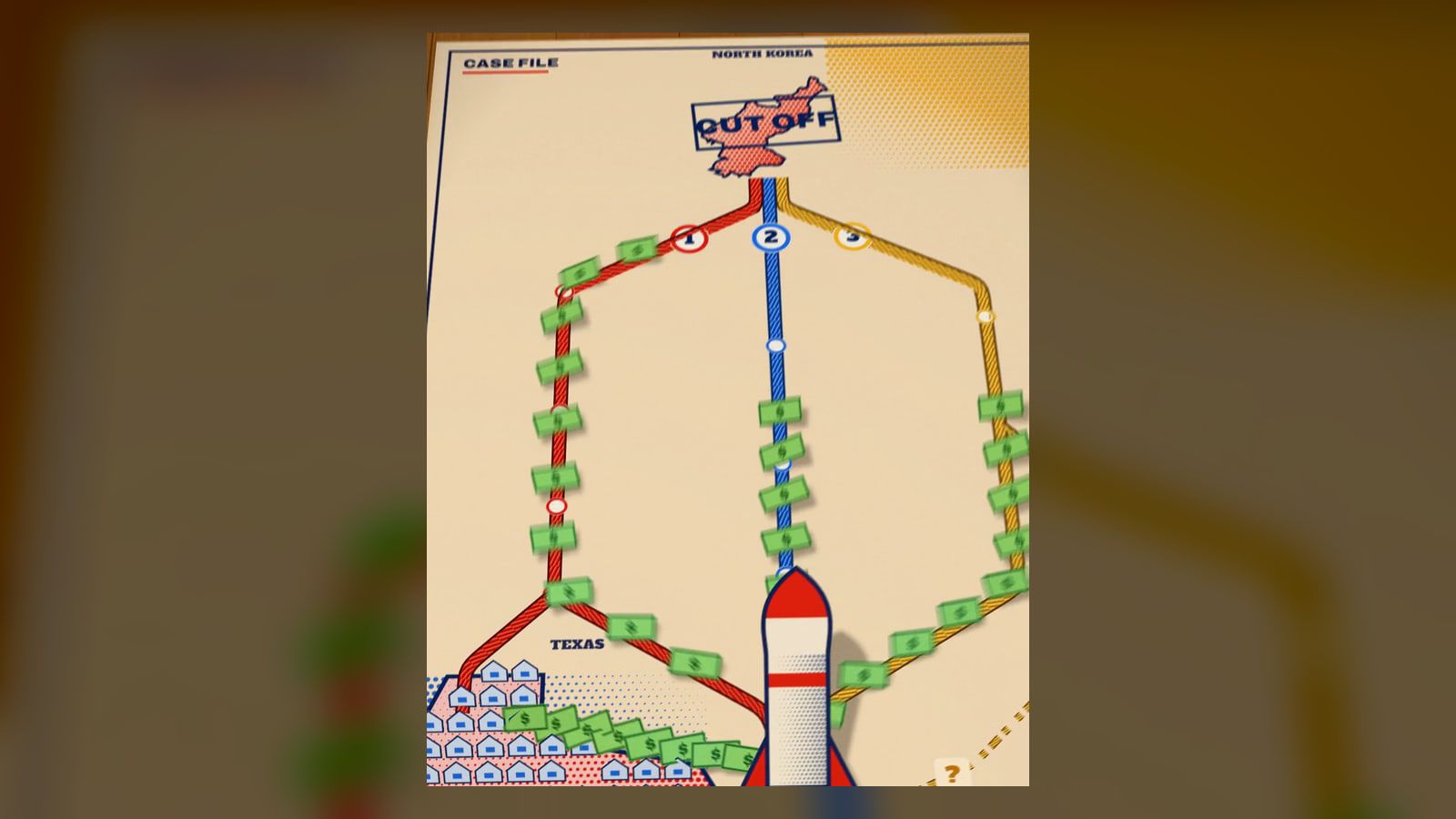
North Korea raises money abroad through at least three online channels, according to US court records and officials: remote IT jobs filled by North Koreans using stolen American identities, ransomware attacks on hospitals, and fake job offers that plant spyware.236 One Arizona laptop farm alone helped workers get hired at 309 US companies, and the Justice Department says farms like it generate revenue for North Korea’s weapons programs.48
The money matters because North Korea is under international sanctions. Hackers linked to the country use “advanced malware, social engineering, and cryptocurrency theft to fund state-sponsored operations and circumvent international sanctions,” the blockchain analysis firm Chainalysis said in 2025.1
Channel 1: fake remote IT workers
The idea is simple. A North Korean worker abroad applies for a remote software job using a stolen US identity, gets hired, and is paid like any other employee. The hard part is looking American, and that is where a US helper comes in.24
From October 2020 to October 2023, Christina Chapman helped North Korean workers obtain the stolen identities of more than 70 US citizens and ran a “laptop farm” at her home, The Record reported from her case.2 Companies mailed work laptops to her house in Litchfield Park, Arizona, addressed to people who did not live there. According to her statement of offense, she installed remote-access software on each one and stuck a handwritten note on it naming the stolen identity and the company, so workers overseas could log in as if they were in the US.4
- 01Stolen identityThe worker applies for a remote job under a real American's name.
- 02HiredThe company ships a work laptop to the 'employee's' US address: the helper's home.
- 03Laptop farmThe helper labels each laptop and installs remote-access software.
- 04Logged in from abroadThe worker uses the laptop remotely, so the company sees a US connection.
Sometimes the cover needed live acting. In November 2022, a worker using the stolen identity “Daniel B.” was hired as a video-streaming engineer by a “top-five national television network and media company” headquartered in New York, The Guardian reported.45 For the IT setup call on Microsoft Teams, Chapman and the overseas worker both joined. “If they ask WHY you are using two devices, just say the microphone on your laptop doesn’t work right,” Chapman told the worker, according to court records quoted by The Guardian.5
The superseding indictment lists 309 US companies defrauded through Chapman’s operation; Fortune identified Nike as one, reporting that about $75,000 was paid to a North Korean worker.4 The operation generated $17.1 million, and Chapman’s own take was about $176,850, roughly 1%.4 She pleaded guilty on February 11, 2025, and on July 24, 2025, was sentenced to 102 months in federal prison.4 State Department officials said three of the North Koreans assisted by Chapman and a co-defendant are linked to the Munitions Industry Department, which “oversees the development of the DPRK’s ballistic missiles.”2
Read also FBI says North Korea's fake video calls stole $400 million in crypto
Channel 2: ransomware against hospitals
The second channel is extortion. In an indictment, prosecutors allege that in May 2021 a group tied to North Korea’s military intelligence agency, the Reconnaissance General Bureau, hit a Kansas hospital with ransomware that locked staff out of X-ray and diagnostic imaging systems.3 Investigators said the hacker charged in the case, Rim Jong Hyok, and his co-conspirators in a group known as Andariel held the hospital’s computer system hostage until administrators paid a Bitcoin ransom.3
According to the charging documents, the hackers targeted hospitals and health care companies, then used ransom payments to buy internet servers for attacks on US, South Korean and Chinese government entities.3 By February 2022, prosecutors said, the group had gained access to NASA’s computer system for over three months and stolen more than 17 gigabytes of unclassified data from its Office of the Inspector General.3 These are allegations in an indictment; they have not been proven in court.
Channel 3: fake dream jobs
The third channel turns hiring against the hirer’s staff. Hackers the US Treasury linked to North Korea’s Lazarus Group posed as recruiters on LinkedIn and put a senior engineer at Sky Mavis, the studio behind the game Axie Infinity, through “multiple rounds of interviews” for a job that did not exist, Business Insider reported.6 The offer letter, with “an extremely generous compensation package,” was laced with spyware. The theft that followed, disclosed in March 2022, took more than $600 million in crypto.6
The same lure turned up again in 2026. According to Binance’s account of its investigation, an engineer was told, near the end of a fake interview with someone claiming to be the CEO of a fictitious company, to download a coding “assignment” onto his work computer.14 Binance estimates about $6.34 billion was affected in the October attack, which the FBI attributes to North Korea’s TraderTraitor group.7 That case is told in full in how the Binance theft happened and on the Binance heist timeline.
How big the channels are
The three channels are not the same size. Crypto theft brings in the largest sums: in 2025 the FBI said North Korea was responsible for the theft of about $1.5 billion from the exchange Bybit, and in 2024 UN experts said they were investigating 58 suspected North Korean cyberattacks between 2017 and 2023, valued at about $3 billion.1213 Where that money goes after a theft is the subject of our explainer on cashing out stolen crypto, and more cases are in Heists & Hacks.
Individual fake-worker cases bring in far less, but the searches keep getting larger: the number of laptops seized in each wave has grown.8910
Show the data
| Item | Value |
|---|---|
| Oct 2024 (8 locations, 3 states) | 70+ |
| Jun 2025 (21 searches, 14 states) | ≈137 |
| 2026 (Operation Lonestar Roundup, Texas) | 187 |
Sources: [8], [9], [10] · October 2024: more than 70 laptops and remote-access devices. June 2025: about 137 laptops. 2026: all of Operation Lonestar Roundup, laptops plus KVM devices (keyboard, video and mouse switches used for remote control).
In June 2025, the Justice Department announced raids on 29 laptop farms across 16 states.10 Between September 21 and 25, 2026, the FBI searched over 40 residences in Texas known or suspected to be laptop farms, part of an effort it calls Operation Lonestar Roundup.89 In October 2026, 14 people were charged over a roughly $3 million scheme that placed North Korean workers at more than 70 US firms; John Eisenberg, the assistant attorney general for national security, said: “North Korea’s rogue regime uses its pervasive IT worker schemes to raise revenue for various illicit purposes.”11
Timeline
- Oct 2020
Christina Chapman begins helping North Korean IT workers with stolen identities and a laptop farm at her Arizona home.2
- May 2021
Prosecutors allege a group tied to North Korea's military intelligence agency hits a Kansas hospital with ransomware.3
- Feb 2022
By this month, prosecutors say, the same group had gained access to NASA's computer system for over three months.3
- Mar 2022
Sky Mavis discloses the theft of more than $600 million, later traced to a fake job offer.6
- Nov 2022
Chapman and an overseas worker both join a TV network's IT setup call as 'Daniel'.5
Show the full timeline (5 more)
- Feb 11, 2025
Chapman pleads guilty.4
- Jun 2025
The Justice Department announces raids on 29 laptop farms across 16 states.10
- Jul 24, 2025
Chapman is sentenced to 102 months in federal prison.4
- Sep 21–25, 2026
The FBI searches over 40 Texas homes known or suspected to be laptop farms.9
- Oct 2026
Fourteen people are charged over a scheme that placed North Korean workers at more than 70 US firms.11
What the FBI tells employers to check
The fake workers do not always leave quietly. In a January 2025 warning, the FBI said North Korean IT workers who are discovered have held stolen code and data for ransom, in some cases publishing a victim’s proprietary code, and have copied company code to personal accounts.15 Its advice to employers who hire remotely:15
- Verify identity during interviews, onboarding and throughout employment, and do as much of the hiring process in person as possible.
- Cross-check applicants: these workers have reused phone numbers and email addresses across résumés.
- Ask simple questions about where the applicant lives and studied, and watch for face-swapping software in video interviews.
- Flag a new shipping address or payment platform during onboarding, and investigate unusual remote connections or logins from many IP addresses.
Where the money goes
US officials tie all three channels to the state. The Justice Department says the devices seized in Texas were used to “generate revenue for the North Korean regime’s sanctioned weapons programs.”8 Prosecutors say the hospital ransoms paid for servers used in further attacks, and The Guardian has described thefts by North Korea’s Lazarus Group as ones “whose proceeds are thought to have funded the regime’s nuclear and ballistic missile programmes.”13
How this story was made: researched and drafted with AI tools from the sources listed below, then checked against those sources claim by claim before publication. The Providers is responsible for everything published here. How we use AI · Report an error. The Providers reports and explains. This is not financial, legal or investment advice.
Sources
Every number and claim above links to one of these. Primary sources are documents from the people or institutions involved.
- 1The GuardianNorth Korea Bybit crypto exchange hack, FBIFeb 27, 2025
- 2The RecordArizona woman pleads guilty in North Korean laptop farm scheme
- 3CBS NewsNorth Korean hacker cyberattacks on NASA, US hospitals, military
- 4True Crime UnheardChristina Chapman's North Korea laptop farm: a crime case
- 5The GuardianNinety laptops, millions of dollars: US woman jailed for role in North Korea remote-work scamAug 3, 2025
- 6Business InsiderAxie Infinity crypto hack: fake job offer letter, spyware, phishingJul 2022
- 7Security AffairsBinance hack: how fake job interviews and AI abuse led to a $6.34 billion attack
- 8US Department of JusticePrimaryJustice Department announces coordinated actions to combat North Korean remote IT worker schemes
- 9US Attorney's Office, Northern District of TexasPrimaryOperation Lonestar Roundup dismantles North Korean IT worker network used to penetrate US
- 10The RecordDOJ raids 29 'laptop farms' in operation against North Korean IT worker schemeJun 30, 2025
- 11The Next WebUS charges 14 over North Korean IT worker scheme at more than 70 companiesOct 14, 2026
- 12FBI / Internet Crime Complaint CenterPrimaryNorth Korea Responsible for $1.5 Billion Bybit HackFeb 26, 2025
- 13Associated Press via SecurityWeekUN experts investigating 58 suspected North Korean cyberattacks valued at about $3 billionFeb 10, 2024
- 14FX News GroupBinance unveils how $6.3 billion hack was done
- 15FBI / Internet Crime Complaint CenterPrimaryNorth Korean IT Workers Conducting Data Extortion (I-012325-PSA)Jan 23, 2025
Follow the cases
A new case every day, as a 90-second video.
Know a story we should open? Suggest a case.
More cases like this
Case 013 · Heists & Hacks
FBI says North Korea's fake video calls stole $400 million in crypto
Case 004 · Heists & Hacks
How North Korea-linked hackers took $6.34 billion from Binance

Case 005 · Heists & Hacks