From our video? This is the full story, with every source.
How North Korea-linked hackers took $6.34 billion from Binance
A tampered installer, a fake CEO, an internal AI tool and one signed permission on Ethereum. How the largest crypto theft on record was set up over five months and run in one night.
By The Providers DeskPublished First told as a video on Nov 4, 20266 min read
In this story
On October 29, 2026, attackers drained about $6.34 billion in crypto from Binance’s hot wallets, the exchange’s always-online accounts for paying out customer withdrawals.13 According to Binance’s November 3 update, they got there through three engineers’ computers over five months: a tampered installer in June, a fake job interview in September and an internal AI tool in October.1 The FBI attributes the theft to North Korea’s TraderTraitor group, and North Korea denies it.712
It is the largest crypto theft on record. This account follows Binance’s own preliminary findings and the on-chain reports by TRM Labs, Blockaid, Chainalysis and Elliptic, and is one chapter of the Binance heist case file, which tracks the money, the freezes and the court orders as they happen. For other cases like it, see our heists section.
Read the video transcript
Binance blocked 57 suspected North Korean attacks this year. Number 58, which the FBI links to North Korea, cost them $6.34 billion. Meanwhile, hackers spent five months working their way inside the company. Here's how the biggest heist in human history was planned.
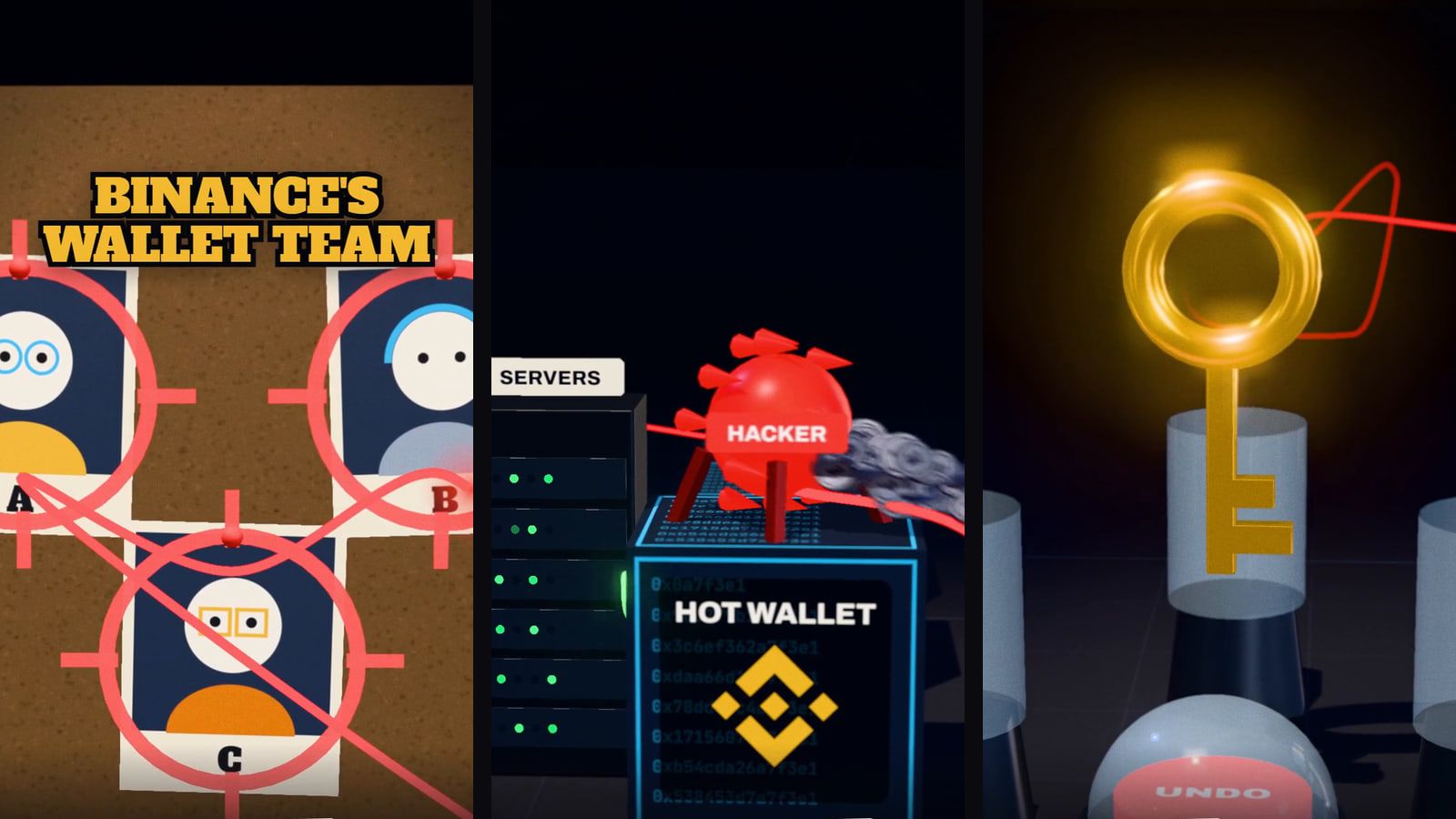
In June, an engineer looking for an AI tool downloads a tampered Homebrew installer. Binance catches it. They give him a new laptop and new passwords. But it's too late. The hackers now know who controls Binance's wallets.
In September, another engineer gets a dream job offer. A fake CEO asks him to download a coding assignment, on his work laptop. It swaps one of his developer tools for a malicious clone.
On October 20, hackers use Binance's own internal AI tool to jump into two wallet engineers' computers. They find a token to deploy code into Binance's wallet system.
October 29, 5:15 PM. The hacker logs into a Binance engineer's computer, and stays there for 2 hours and 41 minutes. 8:05 PM. 233 million XRP, gone in 4 minutes. Then 970,500 Solana. 44.2 million Optimism. 18,270 Bitcoin.
Binance freezes withdrawals. But the money keeps leaving. The hacker had planted a permission directly on the blockchain, giving his contract control of a Binance hot wallet. Shutting down Binance's systems did nothing. And Binance's wallet uses a setup where no single key exists. Their own security made it impossible to quickly hit undo. Engineers had to invent a fix live, while billions drained.
At 11:56 PM, the last transfer clears. At 12:10, the backdoor finally closes. $6.34 billion hit. $2.85 billion frozen.
Five months, three laptops
The first opening came in June. An engineer on Binance’s wallet DevOps team searched online for a popular AI coding tool and installed it with a tampered copy of Homebrew, a common installer for developers on Macs.12 Binance’s security team spotted the anomaly, replaced his laptop and rotated his credentials. But the damage was done: Binance says the engineer’s role, and the colleagues around him on the wallet team, had been exposed.2
In September a second engineer, whose profile on a legitimate job site mentioned his Binance experience, was contacted by someone posing as a project director.2 An interview with a supposed HR representative was followed by a second round with a man claiming to be the CEO of a company that did not exist. Near the end, the engineer was told to download a coding “assignment” onto his work computer. It carried what Binance calls zero-day malware, unknown to its security tools at the time, and it replaced a legitimate developer tool, pyenv, with a malicious copy.12
On October 20 the attacker used that machine as a springboard. Through an internal Binance AI tool, it took control of two wallet engineers’ computers, including the June victim’s, and found a token that allowed code to be deployed into Binance’s wallet system.12 It was not the first try: Binance’s security team says it had detected and stopped 57 suspected North Korea-linked attacks since the start of 2026.1
October 29: 2 hours 41 minutes, then 20 minutes
At 17:15 UTC on October 29, the attacker logged onto the third engineer’s computer, used the stolen credentials to deploy a container and started a malicious script. The session lasted until 19:56.12 Binance says this gave the attacker unauthorized access to its internal wallet signing service, the system that approves outgoing transfers, and let it bypass the normal withdrawal process.1 Binance said it found no evidence that any wallet private key leaked.9
Nine minutes later the money began to move. Between 20:05 and 20:09 UTC, five Binance wallets sent 233.46 million XRP to one address, and at 20:20 a Bitcoin hot wallet sent 18,270 BTC, worth about $1.47 billion.3 TRM Labs counted outflows on ten blockchains, most of them within about 20 minutes. Ethereum alone accounted for about $3.79 billion.3
Show the data
| Item | Value |
|---|---|
| Ethereum | $3.79B |
| Bitcoin | $1.47B |
| Tron | $628M |
| XRP Ledger | $296M |
| Solana | $96M |
| Arbitrum, Optimism and Base | $39M |
| Avalanche | $28M |
| Polygon | $10M |
Source: [3] · TRM Labs' count, about $6.36 billion in total, at prices at the time of the theft.
Read also Where $6 billion in stolen crypto actually goes: the Binance loot, traced
Why switching everything off did not stop it
Binance suspended withdrawals, yet money kept leaving one Ethereum hot wallet for more than three hours. The reason is a feature called EIP-7702, added to Ethereum in May 2025, which lets an ordinary wallet hand control of its behavior to a smart contract by signing an authorization.3
At 20:20:59 UTC the attacker sent one transaction to the wallet known as Binance 14, carrying 50 such authorizations, each written for a different transaction count, or nonce. The wallet was still paying out customer withdrawals, so the attacker could not know which count would be current when it landed. Forty-nine failed and one matched.4 At 20:24:23 the attacker’s contract emptied the wallet: 167,464 ETH, 1.615 billion USDT and about 60 other tokens in a single transaction.4
The permission lived on the blockchain, not on Binance’s servers, so suspending withdrawals and shutting down hot-wallet services did not cancel it.1 Rotating to new keys would not have cleared it either, because the delegation belongs to the address; the only fix is a new authorization from the same wallet.4 Binance’s hot wallets use multi-party computation, which splits signing among several parties so that no single private key exists. That left no key at hand to sign the undo, and engineers had to build a revocation procedure while the attacker swept fresh deposits out of the wallet six more times between 20:41 and 23:56 UTC.13
The last unauthorized transfer, 2,961.9 ETH, settled at 23:56 UTC. At 00:10 on October 30, Binance signed the authorization that pointed the wallet back to the empty “zero” address and closed the door.1
- 2 h 41 m
- the attacker was logged in before the first transfer (17:15 to 19:56)
- 56 min
- from the first transfer (20:05) to the first freeze, by Tether (21:01)
- 4 h 05 m
- from the first transfer until Binance closed the backdoor (00:10)
Timeline
- Jun 2026
A wallet DevOps engineer installs a tampered Homebrew installer while looking for an AI coding tool. Binance replaces his laptop and rotates his credentials.21
- Sep 2026
A second engineer, in a fake job interview, downloads a coding 'assignment' that plants zero-day malware on his work computer.12
- Oct 20
Through an internal AI tool, the attacker reaches two wallet engineers' computers and finds a deployment token.1
- Oct 29 · 17:15 UTC
The attacker logs onto a third engineer's computer, deploys a container and starts the attack script. Logged in until 19:56.1
- Oct 29 · 20:05 UTC
First transfers: 233.46 million XRP leave five Binance wallets in four minutes.3
Show the full timeline (7 more)
- Oct 29 · 20:20 UTC
18,270 BTC leave a Bitcoin hot wallet. Seconds later, one transaction with 50 signed authorizations hands an Ethereum hot wallet to the attacker's contract.43
- Oct 29 · 20:24 UTC
The main sweep: 167,464 ETH, 1.615 billion USDT and about 60 other tokens in one transaction.4
- Oct 29 · 21:01 UTC
Tether freezes 971.1 million USDT in the main receiving wallet; Circle freezes 823 million USDC at 21:04.3
- Oct 29 · 23:56 UTC
The last unauthorized transfer, 2,961.9 ETH, settles on-chain.1
- Oct 30 · 00:10 UTC
Binance signs a new authorization that clears the attacker's delegation.1
- Oct 31
The FBI attributes the theft to North Korea's TraderTraitor group and publishes the addresses holding the funds.87
- Nov 3
Binance publishes its preliminary findings; Kim Yo Jong calls the FBI's accusation a political provocation.121
How big is $6.34 billion?
The totals differ because each firm tracks a slightly different set of wallets, and prices moved during the theft. Binance puts the assets affected at $6.34 billion, TRM Labs at $6.36 billion, Chainalysis at about $6.4 billion and Elliptic at $6.43 billion.1365 On any count it is more than four times the $1.46 billion taken from Bybit in February 2025, until then the biggest hack of an exchange; the FBI attributed that theft to TraderTraitor too.5101115 The largest crypto theft before Binance’s was not an exchange at all: the blockchain analytics firm Arkham found in 2025 that LuBian, a Chinese bitcoin mining pool, had lost 127,426 BTC, about $3.5 billion at the time, in December 2020.16
Elliptic goes further. It calls the Binance theft almost certainly the largest known theft of any kind, more than six times the $1 billion Saddam Hussein took from Iraq’s central bank on the eve of the 2003 war.510
Show the data
| Item | Value |
|---|---|
| Binance (Oct 2026) | $6.34B |
| LuBian mining pool (Dec 2020) | $3.50B |
| Bybit (Feb 2025) | $1.46B |
| Central Bank of Iraq, cash (2003) | $1.00B |
| Ronin Network (Mar 2022) | $0.62B |
| Poly Network (Aug 2021) | $0.61B |
| BNB Bridge (Oct 2022) | $0.59B |
| Bitget (Sep 2026) | $0.39B |
Sources: [1], [5], [10], [11], [16] · Binance's own figure; Elliptic counts $6.43B. Amounts at the time of each theft, not adjusted for inflation. Most of the Poly Network funds were later returned. The LuBian theft came to light only in 2025.
Binance says its customers will not carry the loss. It reserved more than the full amount from its SAFU emergency fund and company money, and says 98% of the affected tokens had already been replaced by October 31.19
Who says North Korea did it, and what happened next
TRM Labs, Chainalysis and Elliptic each linked the theft to TraderTraitor within a day; Chainalysis says stolen Binance funds mixed on-chain with money from September’s Bitget theft, which was also attributed to North Korea.36 On October 31 the FBI said North Korea was responsible. It published the addresses holding the funds and asked exchanges and DeFi services to block transactions tied to them.78 On November 3, Kim Yo Jong, the sister of North Korea’s leader, called the accusation a political provocation, according to Yonhap.12
About $2.85 billion, mostly stablecoins whose issuers can lock a wallet, has been frozen or intercepted, Binance says.1 On November 12 the Justice Department said it had court authorization to seize or restrain more than $1.2 billion of the frozen funds,13 and on November 18 Binance said an Abu Dhabi court had granted it a worldwide freezing order of up to $6.5 billion.14 We follow the rest of the money in where the stolen Binance crypto went, and the US action in the $1.2 billion seizure.
How this story was made: researched and drafted with AI tools from the sources listed below, then checked against those sources claim by claim before publication. The Providers is responsible for everything published here. How we use AI · Report an error. The Providers reports and explains. This is not financial, legal or investment advice.
Sources
Every number and claim above links to one of these. Primary sources are documents from the people or institutions involved.
- 1BinancePrimaryBinance Security Incident on October 30, 2026: Update on Preliminary Investigation Findings and ResponseNov 3, 2026
- 2FX News GroupBinance unveils how $6.3 billion hack was doneNov 3, 2026
- 3TRM LabsPrimaryNorth Korea Steals USD 6.36 Billion From Binance in the Largest Hack in HistoryOct 30, 2026
- 4BlockaidPrimaryBinance $6.3B Hack: Using Advanced AI Models, Blockaid Detects the Biggest Theft in Crypto HistoryOct 29, 2026
- 5EllipticPrimaryThe largest theft in history: North Korea behind the $6.4 billion Binance hackOct 30, 2026
- 6ChainalysisPrimaryThe $6.4 Billion Binance Hack: Tracing the North Korea LinkOct 30, 2026
- 7FBIPrimaryNorth Korea Responsible for $6 Billion+ Binance AttackOct 31, 2026
- 8The RecordFBI blames N. Korea's TraderTraitor for Binance theft, urges crypto industry to block transactionsNov 2, 2026
- 9DecryptBinance finds 'additional points of breach' in $6.3B hackOct 30, 2026
- 10EllipticPrimaryThe largest theft in history - following the money trail from the Bybit HackFeb 23, 2025
- 11RektLeaderboardNov 20, 2026
- 12ForkLogNorth Korea denies involvement in $6.3 billion Binance hackNov 3, 2026
- 13US Department of JusticePrimaryJustice Department Announces Actions to Disrupt North Korea's Massive Theft of CryptocurrencyNov 12, 2026
- 14The BlockBinance obtains $6.5 billion freezing order from Abu Dhabi court in bid to recover stolen cryptoNov 18, 2026
- 15FBI / IC3PrimaryFBI PSA: North Korea Responsible for $1.5 Billion Bybit HackFeb 26, 2025
- 16Cointelegraph$3.5B Bitcoin heist from 2020 retroactively uncovered — Arkham IntelAug 2, 2025
Follow the cases
A new case every day, as a 90-second video.
Know a story we should open? Suggest a case.
More cases like this
Case 005 · Heists & Hacks
Where $6 billion in stolen crypto actually goes: the Binance loot, traced
Case 008 · Heists & Hacks
Why the Binance hackers made six meme coins for about $90 each

Case 014 · Heists & Hacks