From our video? This is the full story, with every source.
McDonald's says prices rose 40% in 5 years. Then it cut deals; visits fell
After years of price rises, McDonald's app deals became the way many regulars bought. When the chain cut them back in 2026, its most loyal customers came less. Here is how the deal trap works.
By The Providers DeskPublished First told as a video on Oct 22, 20265 min read
In this story
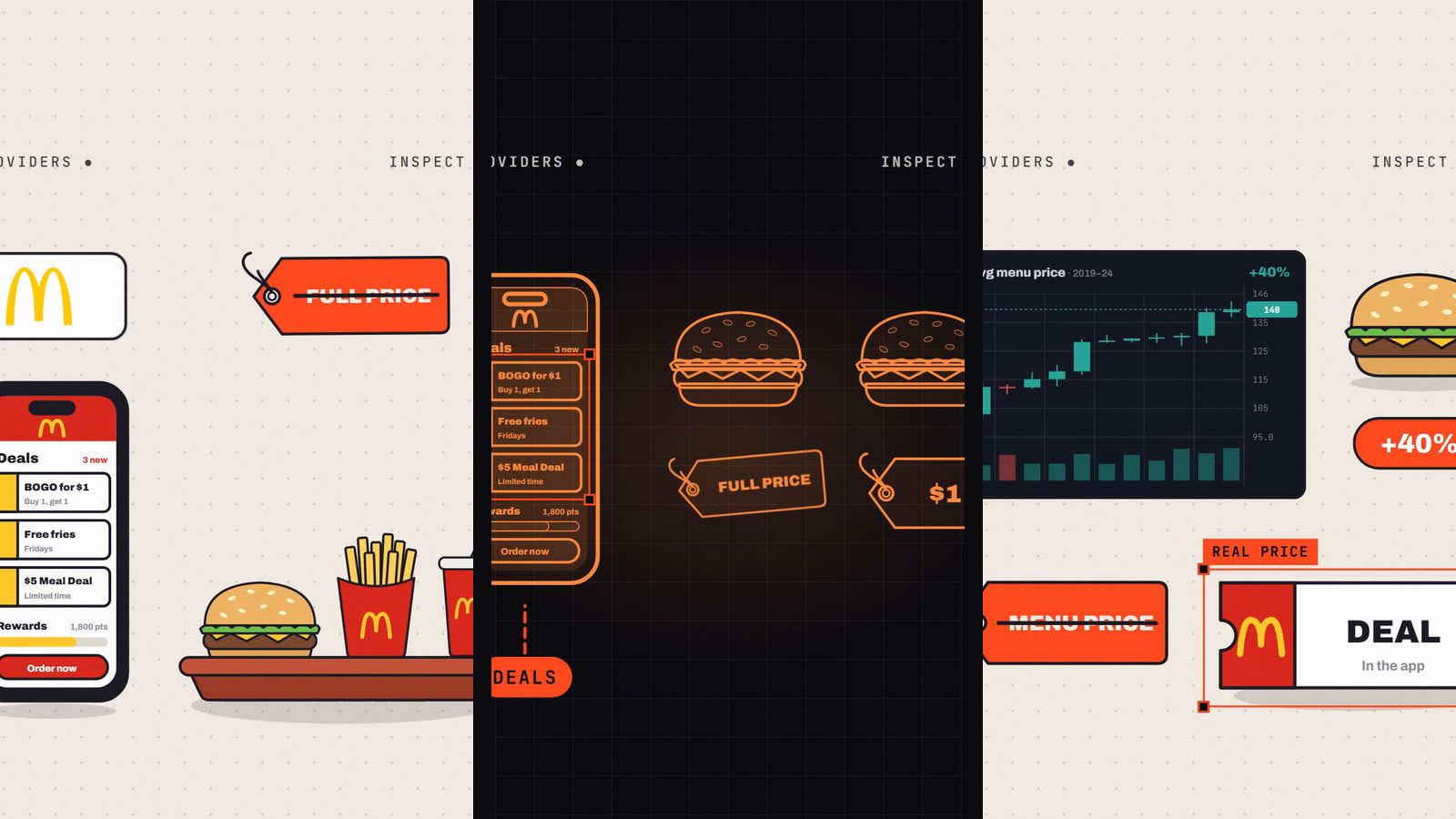
McDonald’s says the average U.S. menu item cost about 40% more in 2024 than in 2019.9 When the chain phased out many app offers earlier in 2026, its finance chief said visits from some of its most loyal customers fell, and by the third quarter U.S. comparable sales were down 0.2%.15
That leaves the chain in a hard spot: its deals had become part of how regulars bought, and taking them away cost visits. McDonald’s is now spending $8.5 billion over the next decade on a plan to win customers back.6
Read the video transcript
You haven't paid full price at McDonald's in months. And McDonald's just admitted that's a problem.
Its U.S. sales grew just 0.8%. It blamed too many promotions, and now it's spending billions to win you back.
The app taught you. Once a second burger costs a dollar, full price feels like a rip-off.
Researchers at MIT and Northwestern found the same: loyal customers given deeper discounts bought less later.
So when McDonald's pulled many app deals this year, some of its most loyal fans came less. Its CEO says customers asked: where is this deal?
Menu prices rose 40% in 5 years. The deal became the real price.
So if a deal pops up, ask if you'd pay full price. And if you sell anything, every discount teaches customers to wait.
How the menu got so expensive
In May 2024, the president of McDonald’s USA, Joe Erlinger, published an open letter about prices. He said the average price of McDonald’s menu items was “up around 40% since 2019,” and that a Big Mac meal averaged $9.29, up 27% from $7.29.9 The letter answered social media claims that prices had more than doubled, and Erlinger put the rises down to higher costs, such as crew pay and the cost of goods.9 He wrote that the company had to “remain laser-focused on value and affordability.”9
Prices are not set only at headquarters. Many McDonald’s restaurants are run by franchisees, independent owners, and the company can recommend a value price without every restaurant using it.5 That matters later in this story.
McDonald’s has leaned heavily on its app. An app offer is tied to a customer’s account, so a discount can go to one person without changing the price on the menu board for everyone else.
How big the app has become
The scale is large. In December 2023, McDonald’s set a goal of $45 billion a year in sales to loyalty members by 2027, up from about $20 billion, and 250 million active users, up from 150 million.10 It counts a member as active if they used the program in the last 90 days.4
Show the data
| Item | Value |
|---|---|
| 2023 (as stated Dec 2023) | ~$20B |
| 2024 | ~$30B |
| 2025 | ~$37B |
| 12 months to Sep 2026 | $41B |
| 2027 goal | $45B |
It is getting close. Loyalty sales were about $30 billion in 2024 and nearly $37 billion in 2025, when the program had nearly 210 million active users across 70 markets.34 By mid-2026 the program had nearly 220 million active users.2 In the 12 months to September 2026, sales to loyalty members reached $41 billion.1 For scale, McDonald’s total systemwide sales were over $130 billion in 2024.4
The app also does more than store coupons. In 2019, McDonald’s bought Dynamic Yield, a personalization company, for a reported $300 million, to change what menus show based on time of day, weather, restaurant traffic and trending items, and to suggest add-ons, first at drive-thrus and then in kiosks and the app.11
Read also Starbucks bets you pay for the chair. Its U.S. visits rose 3.4%
What happened when the deals stopped
Earlier in 2026, McDonald’s phased out many digital promotions and its “Buy One, Get One for $1” deal, replacing them with a value menu that sold many items under $3, CNN reported.5 It did not go to plan. Chief financial officer Ian Borden said only about 65% of restaurants used the recommended pricing, and some raised prices on items while staying under $3.5
At the same time, restaurants were launching tie-ins and new items. Chief executive Chris Kempczinski said restaurants “were overwhelmed by too many deployments in the quarter,” which slowed service.5 Borden put it plainly: “In combination, all of these factors negatively impacted visits from some our most loyal customers.”5
- +6.8%
- Oct–Dec 2025
- +0.8%
- Apr–Jun 2026, after many app deals ended
- -0.2%
- Jul–Sep 2026, fewer guests
The numbers followed. U.S. comparable sales, which compare restaurants open at least a year, had risen 6.8% in the last quarter of 2025.3 They rose just 0.8% in the second quarter of 2026, down from 2.5% a year earlier, with fewer guests.2 In the third quarter they fell 0.2%; the company said “negative comparable guest counts were largely offset by positive check growth,” meaning fewer people came in but each spent more.1 In between, on the day of the second-quarter results, CNN reported that Joe Erlinger, president of McDonald’s USA since 2019, was leaving immediately, replaced by Skye Anderson, a 26-year company veteran.5
Why deals are hard to take back
Marketing researchers have tested this. Eric Anderson of Northwestern’s Kellogg School of Management and Duncan Simester of MIT Sloan ran three large field experiments, published in 2004.812 Their summary: “Deeper price discounts in the current period increased future purchases by first-time customers but reduced future purchases by established customers.”8 Among the explanations they examined were customers learning to expect deals and becoming more sensitive to them.8
The experiments involved a mail-order catalog selling durable goods, not burgers, so they do not prove what happened at McDonald’s. But the pattern matches what McDonald’s executives described: some of the most loyal customers were the ones who pulled back when the deals changed.58
That is the trap our video describes: once a second burger costs a dollar, the full price starts to look like a markup. A deal brings in new customers, but it also resets what regulars think a burger is worth.
Deals also cost the people who run the restaurants. When McDonald’s planned a $5 value meal in 2024, the National Owners Association, an independent franchisee advocacy group, warned: “There simply is not enough profit to discount 30% for this model to be sustainable.”9 That tension, between headquarters wanting traffic and owners wanting margin, is part of every decision about app deals.
Timeline
- Mar 2019
McDonald's buys Dynamic Yield, a personalization firm, to tailor menus and suggest add-ons in its app and drive-thrus.11
- Dec 2023
McDonald's targets $45 billion a year in sales to loyalty members by 2027, up from about $20 billion.10
- May 2024
McDonald's USA's president says the average menu item costs about 40% more than in 2019.9
- H1 2026
Many app promotions and the 'Buy One, Get One for $1' deal are phased out for a value menu.5
- Aug 4, 2026
U.S. comparable sales grow just 0.8%; executives say loyal customers' visits fell.5
- Sep 24, 2026
McDonald's sets out an $8.5 billion plan through 2036 to win customers back.6
- Nov 4, 2026
U.S. comparable sales fall 0.2% as guest counts decline.1
The plan to win them back
McDonald’s has since changed course. In September 2026 it laid out a plan it calls “Next,” with $8.5 billion to be spent by 2036 and about $5 billion in the next three and a half years, on remodels, rent relief for franchisees, retraining its 2 million workers and new menu items.6 CNN reported that the chain had blamed its slowdown on “launching too many promotions, plus inadequate customer service.”6 CNN also reported that a new value menu to replace the “$3 and Under” menu was being discussed with franchisees.6
The deals came back too. In the third quarter, “more digital offers, such as a $2 breakfast sandwich and free fries with a $1 purchase, lured more members” of the loyalty program, Restaurant Business reported.7 Kempczinski said the company was “encouraged by improvement as the quarter progressed following our intervention on value,” and McDonald’s aims to launch a national entry-level value program early in 2027.17
Starbucks faced a mirror image of this problem: it trained customers to grab and go, then had to pay to bring the seats back, as we explain in the Starbucks third place story. Both sit in our price-tag coverage, alongside what happened to J.C. Penney’s sales when it dropped its ‘was’ prices.
How this story was made: researched and drafted with AI tools from the sources listed below, then checked against those sources claim by claim before publication. The Providers is responsible for everything published here. How we use AI · Report an error.
Sources
Every number and claim above links to one of these. Primary sources are documents from the people or institutions involved.
- 1McDonald's / SECPrimaryMcDonald's Reports Third Quarter 2026 Results (Form 8-K, Exhibit 99.1)Nov 4, 2026
- 2McDonald'sPrimaryMcDonald's Reports Second Quarter 2026 ResultsAug 4, 2026
- 3McDonald'sPrimaryMcDonald's Reports Fourth Quarter and Full Year 2025 ResultsFeb 11, 2026
- 4McDonald'sPrimaryMcDonald's Reports Fourth Quarter and Full Year 2024 ResultsFeb 10, 2025
- 5CNN (via KION)McDonald's sales in the US are slowing after deal fatigueAug 4, 2026
- 6CNN (via KEYT)McDonald's is spending billions to make major changesSep 24, 2026
- 7Restaurant Business (via Nation's Restaurant News)McDonald's U.S. same-store sales decline on weak trafficNov 4, 2026
- 8Kellogg School of Management, Northwestern UniversityPrimaryLong-Run Effects of Promotion Depth on New Versus Established Customers: Three Field Studies (Marketing Science)2004
- 9CNBC (via NBC News)McDonald's exec says average menu item costs 40% more than in 2019May 29, 2024
- 10PYMNTSMcDonald's Targets 250 Million Rewards Users by 2027 as QSRs Boost PersonalizationDec 7, 2023
- 11Retail TouchPointsMcDonald's Acquires Personalization Provider Dynamic Yield For $300 MillionMar 26, 2019
- 12MIT Sloan School of ManagementDuncan Simester, faculty profile
Follow the cases
A new case every day, as a 90-second video.
Know a story we should open? Suggest a case.
More cases like this
Case 002 · Price Tag
Starbucks bets you pay for the chair. Its U.S. visits rose 3.4%
Case 010 · Price Tag
GTA 6's estimated $2.36 billion launch, and what the sick-day surveys miss
Case 007 · Price Tag