From our video? This is the full story, with every source.
J.C. Penney dropped its 'was' prices. Its sales fell $4 billion
In 2012 J.C. Penney swapped hundreds of sales for one everyday price, and shoppers left. What that year, the research and the law say about Black Friday's 'was' prices.
By The Providers DeskPublished First told as a video on Nov 9, 20266 min read
In this story
J.C. Penney’s sales fell by about $4.3 billion in 2012, the year it stopped running hundreds of sales and put one everyday price on its tags. Revenue dropped 24.8%, to $12.985 billion from $17.26 billion, and the company lost $985 million, according to its own results.1 By April 2013 the chief executive behind the change was gone, and the chain was already raising some regular prices again so it could mark them down.1819
That year became a rare real-world test of a question every Black Friday raises: do shoppers want an honest price, or the feeling of a bargain? Researchers, regulators and judges have all weighed in on “was” prices. With Black Friday on November 27, 2026, here is what they found, and how to check whether a discount is real. Our Price Tag stories look at what else a price pays for, from the chair at Starbucks to McDonald’s app deals.
What J.C. Penney changed in 2012
Ron Johnson came from Apple; when J.C. Penney hired him in June 2011, Fortune called him “the man who built the Apple Store.”14 He took J.C. Penney’s top job in November 2011.16
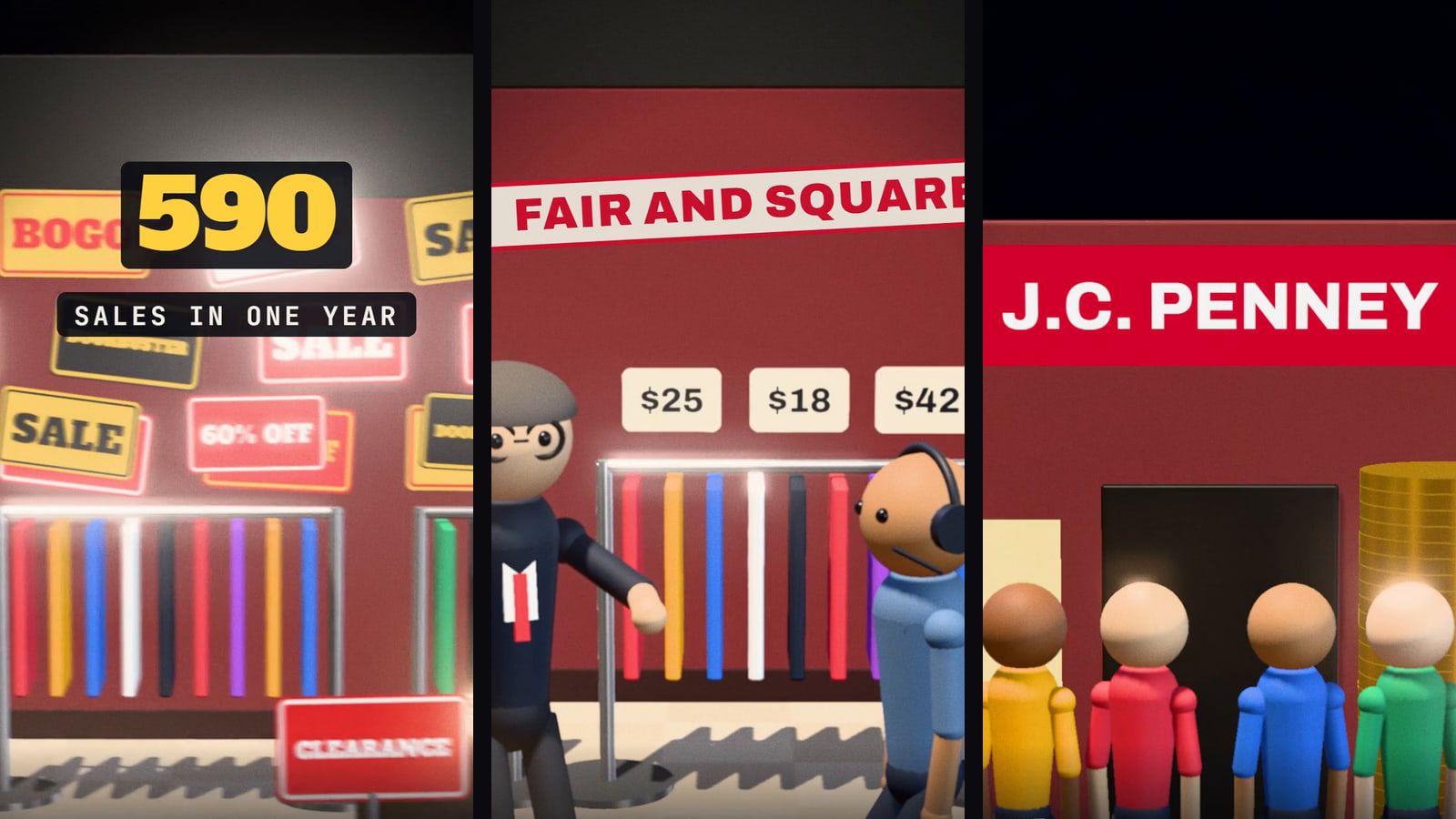
The chain he inherited ran on promotions: 590 of them in 2011, according to Retail Dive, or “nearly 600 fleeting discounts, coupons and sales,” as the Associated Press put it.1516 Johnson’s plan cut that to 12 themed, month-long promotions a year.1315
The new system, called Fair and Square, started on February 1, 2012.2 It had three kinds of price: everyday prices shown in red, “month-long values” on chosen items, and “best prices” on the first and third Fridays of each month.13 Everyday prices were set about 40% below 2011’s tag prices, with no coupons. “Customers will not pay literally a penny more than the true value of the product,” Johnson told the AP.13
How the year went, quarter by quarter
Comparable-store sales, which count only stores open at least a year, fell in every quarter of 2012, and each fall was deeper than the last.3451 The worst was the holiday quarter, which includes Black Friday.
Show the data
| Item | Value |
|---|---|
| Feb–Apr 2012 | −18.9% |
| May–Jul 2012 | −21.7% |
| Aug–Oct 2012 | −26.1% |
| Nov 2012–Jan 2013 (holidays) | −31.7% |
Sources: [3], [4], [5], [1] · Change against the same quarter a year earlier. Fiscal 2012 ran from February 2012 to early February 2013.
On Black Friday 2012, J.C. Penney offered what the magazine Chief Executive later called “half-hearted discounts,” which looked underwhelming next to 80% off at rival stores.17 For the full year, the company said, “Sales and customer traffic were below our expectations in 2012.”1
The retreat began while Johnson was still in charge. In January 2013, the AP reported the chain would add sales again; Johnson said, “I still believe that the customer knows the right price, but they want help.”16 In March, J.C. Penney started raising regular prices on its own brands so it could discount them. A company spokesperson’s example was “an Arizona crewneck T-shirt that sold for $5, is now priced at $6,” and the company said, “we now understand that customers are motivated by promotions and prefer to receive discounts.”19
In April 2013, J.C. Penney parted ways with Johnson and rehired his predecessor, Myron Ullman.18 The Bangor Daily News summed up the year: shoppers “balked at Johnson’s pricing strategy, which he did not bother to test.”18
Timeline
- Jun 2011
J.C. Penney picks Ron Johnson, who built Apple's retail stores, as its next chief executive.14
- Nov 2011
Johnson takes the top job.16
- Feb 1, 2012
Fair and Square pricing starts: everyday prices, month-long offers and two 'best price' Fridays a month.2
- Feb 8, 2012
A California shopper files a class action over J.C. Penney's earlier 'original' prices.6
- Nov 2012
J.C. Penney's Black Friday discounts look mild next to rivals' 80% off, Chief Executive later reported.17
Show the full timeline (6 more)
- Jan 2013
The chain says it will add more sales again.16
- Feb 27, 2013
J.C. Penney reports 2012 sales down 24.8% and a $985 million loss.1
- Mar 2013
It raises regular prices on its own brands so they can be marked down.19
- Apr 2013
Johnson leaves; former CEO Myron Ullman returns.18
- Sep 2015
The class action settles with a $50 million fund; J.C. Penney denies the allegations.6
- Jan 25, 2016
A federal judge gives the settlement preliminary approval.6
Read also McDonald's says prices rose 40% in 5 years. Then it cut deals; visits fell
Why a “was” price works on shoppers
Marketing researchers call a “Sale” sign, a struck-through “was” price or a “compare at” label a price cue: a signal that a price is good value, separate from the price itself. Eric Anderson of Kellogg and Duncan Simester of MIT Sloan reviewed the evidence in 2008.10 Their starting point is that many customers have poor price knowledge. In one widely cited study, fewer than half of supermarket shoppers could correctly recall the price of an item they had just put in their cart.10
That gap is what a cue fills. In the authors’ own tests, a retailer mailed different customers catalogs that were “identical except for the experimental variation in prices or price cues,” and demand for one dress rose 58% when it carried a “Sale” sign.10 A study of US carmakers’ “employee pricing” offers in 2005 found demand rose sharply even on models whose employee price was higher than the price just before the promotion.10
Cues also wear out. Category demand for frozen orange juice fell once more than 30% of items carried sale signs, and showing the regular price can backfire: printing “Regular Price $120, Sale $96” sold fewer dresses than “Sale $96” alone, because customers had expected more than a $24 saving.10
- 58%
- more demand for a catalog dress when it carried a 'Sale' sign
- Under 50%
- of shoppers in one study correctly recalled a price they had just put in their cart
- 30%
- share of items with sale signs above which frozen orange juice demand fell
Source: [10]
What the law says about “was” prices
In the US, the Federal Trade Commission’s pricing guides say a “was” price is a fair basis for a sale if it is the “actual, bona fide price” offered “for a reasonably substantial period of time.” The guides call it a false bargain “where an artificial, inflated price was established for the purpose of enabling the subsequent offer of a large reduction.”7
Private lawsuits test those lines. A shopper named Cynthia Spann sued J.C. Penney in federal court in California on February 8, 2012, alleging that before Fair and Square its higher “regular” and “original” prices were ones it “hardly, if ever, offered, sold or intended to sell.” She also alleged the company “temporarily stopped using false price comparisons” in February 2012 and returned to them “in early 2013.”6 The settlement covered California purchases of J.C. Penney’s own or exclusive brands bought at 30% or more off, from November 2010 to January 2012 and from January 2013 to December 2014: the months before and after Fair and Square.6
J.C. Penney agreed to a $50 million fund, paid as cash or store credit, and promised any former price it advertises will be “the actual, bona fide price at which the item was openly and actively offered for sale.”6 It denied the allegations.20
A federal appeals court has agreed that these prices matter. In 2013 the Ninth Circuit revived a suit accusing Kohl’s of fake discounts, ruling that a shopper who buys “on the basis of false price information” has suffered an economic injury. “In sum, price advertisements matter,” the judges wrote, quoting research that “the presence of a higher reference price enhances subjects’ perceived value.”8
The European Union goes further with a fixed number. A shop announcing a reduction must calculate it from the lowest price it charged in at least the previous 30 days, the EU Court of Justice confirmed in 2024, so that traders cannot raise a price “before announcing a price reduction.”9
How to check a Black Friday discount
A long-running check on Black Friday deals comes from Which?, the UK consumer group, which tracks prices for six months before and after the day. Of 227 deals from Black Friday 2023, 92% were the same price or cheaper at other times of the year, and 11% had been cheaper in the six months before.11 Its study of 2020 deals found just one of 201 products was at its cheapest only on Black Friday.12 These are UK retailers, but the method works anywhere.
- 92%
- of 2023 deals were the same price or cheaper at other times of the year
- 11%
- of 2023 deals had been cheaper in the six months before Black Friday
- 1 of 201
- 2020 deals was at its lowest price only on Black Friday
Which?’s own advice is simple. Judge the price, not the claimed saving, and look up the item’s price history with a tracker such as PriceRunner or CamelCamelCamel, which covers Amazon only. Don’t feel rushed: good prices usually come back.11
The J.C. Penney case adds one more point. The settlement covered a store’s own and exclusive brands, items sold nowhere else, so their “was” price cannot be checked at another shop.6 For those, a price history is the only real test.
How this story was made: researched and drafted with AI tools from the sources listed below, then checked against those sources claim by claim before publication. The Providers is responsible for everything published here. How we use AI · Report an error.
Sources
Every number and claim above links to one of these. Primary sources are documents from the people or institutions involved.
- 1J.C. Penney / SECPrimaryJ. C. Penney Company, Inc. reports 2012 fiscal fourth quarter and full year results (Form 8-K, Exhibit 99)Feb 27, 2013
- 2J.C. Penney / SECPrimaryFourth quarter and full year 2011 results (Form 8-K, Exhibit 99)Feb 24, 2012
- 3J.C. Penney / SECPrimaryFirst quarter 2012 results (Form 8-K, Exhibit 99)May 15, 2012
- 4J.C. Penney / SECPrimarySecond quarter 2012 results (Form 8-K, Exhibit 99)Aug 10, 2012
- 5J.C. Penney / SECPrimaryThird quarter 2012 results (Form 8-K, Exhibit 99)Nov 9, 2012
- 6US District Court, Central District of CaliforniaPrimarySpann v. J.C. Penney Corp., order preliminarily approving class action settlement, Case No. CV 12-0215 FMOJan 25, 2016
- 7Federal Trade Commission, via Cornell Legal Information InstitutePrimary16 CFR 233.1, Former price comparisons (FTC Guides Against Deceptive Pricing)
- 8US Court of Appeals for the Ninth Circuit, via FindLawPrimaryHinojos v. Kohl's Corporation, No. 11-55793May 21, 2013
- 9Court of Justice of the European UnionPrimaryA price reduction announced in an advertisement must be calculated on the basis of the lowest price in the last 30 days (Case C-330/23, Aldi Süd)Sep 26, 2024
- 10Eric T. Anderson (Kellogg) and Duncan I. Simester (MIT Sloan)PrimaryPrice Cues and Customer Price KnowledgeJan 2008
- 11Which?Black Friday deals exposed as dudsNov 26, 2024
- 12Which?99.5% of Black Friday deals cheaper or the same price at other times of the yearNov 23, 2021
- 13ABC NewsWhat to expect: J.C. Penney's new pricing strategyJan 31, 2012
- 14FortuneThe man who built the Apple Stores leaves for J.C. PenneyJun 14, 2011
- 15Retail DiveWas Ron Johnson right?Mar 1, 2016
- 16Associated Press, via MPR NewsThey're back: J.C. Penney adds salesJan 28, 2013
- 17Chief Executive5 critical errors that triggered Ron Johnson's removal at JC PenneyApr 18, 2013
- 18Bangor Daily NewsJ.C. Penney ousts CEO, former boss returns to helmApr 9, 2013
- 19Coupons in the NewsJCPenney raises prices, so it can lower them againMar 27, 2013
- 20Top Class ActionsJ.C. Penney agrees to $50M false advertising settlementNov 13, 2015
Follow the cases
A new case every day, as a 90-second video.
Know a story we should open? Suggest a case.
More cases like this
Case 003 · Price Tag
McDonald's says prices rose 40% in 5 years. Then it cut deals; visits fell
Case 002 · Price Tag
Starbucks bets you pay for the chair. Its U.S. visits rose 3.4%
Case 010 · Price Tag